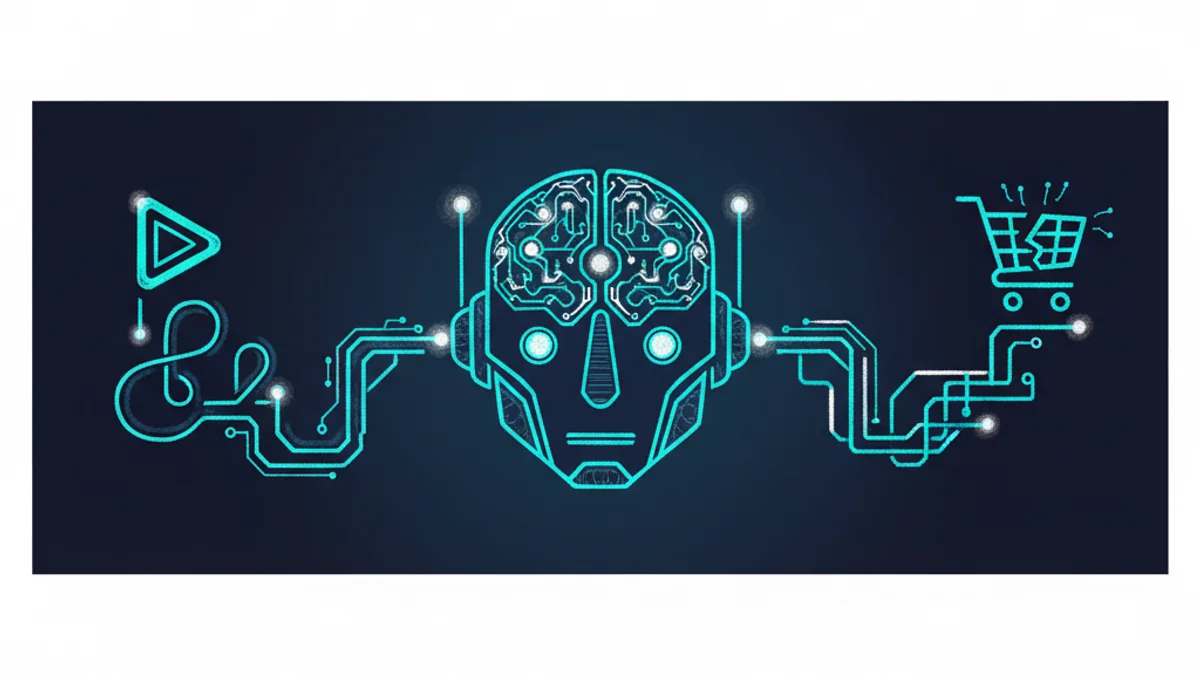
The Netflix Paradox: Why Shopping Isn't "Streaming" Yet
Spotify knows what song you want to hear next. Netflix queues up your next binge. But your favorite retailer? Still making you filter by Men > Shirts > Size L. After 15 years of personalization promises, why doesn't shopping work like streaming?
Nino Chavez
Product Architect at commerce.com
Here’s the question that’s been nagging at me: Why does my Spotify feed know exactly what I want to hear next, but my favorite clothing retailer still makes me filter by “Men > Shirts > Size L”?
The vision of a fully personalized, algorithmic “Assortment Feed” is the Holy Grail. It’s what personalization vendors have been promising for 15 years.
We’re not there yet. And I used to think it was just a matter of better algorithms or cleaner data.
I was wrong. The problem is structural.
The Data Density Gap (The “Signal” Problem)
This is the biggest hurdle. And it’s not what most people think.
Media (Spotify/Netflix): You generate thousands of signals a week. You listen to 300 songs. You watch 10 episodes. You skip tracks. You pause. You rewind. The data is dense, continuous, and low-stakes.
Commerce: You buy a winter coat once every 3 years. You buy toothpaste once a month.
The consequence? Commerce algorithms are data-starved. They’re trying to predict your next move based on a purchase you made 6 months ago. That’s why they fail.
Netflix knows your mood today. Right now.
Retailers only know your history.
The Physics of Inventory (The “Stock” Problem)
Here’s where it gets worse.
Media: Inventory is infinite. Netflix never runs out of Stranger Things. It costs them $0 to stream it to one more person.
Commerce: Inventory is finite. If an algorithm builds a perfect “Personalized Homepage” for you featuring a specific sneaker, and that sneaker runs out of stock in your size 10 minutes later, the experience breaks. Hard.
The conflict gets deeper. Merchandising teams have business goals (clearing slow-moving inventory) that often conflict with personalization goals (showing you what you actually want). Netflix doesn’t care which movie you watch. The retailer needs you to buy the overstocked sweaters.
The algorithm serves two masters. And one of them signs the checks.
The “Hunter” vs. “Gatherer” Intent
This is the one that killed most “personalization platforms.”
Media: You almost always go to TikTok or Netflix to be entertained (Passive/Gatherer). The algorithm works because you’re surrendering control. You’re saying, “Show me what I didn’t know I wanted.”
Commerce: Half the time, you’re a “Hunter.” You need AA batteries. Now. You know exactly what you want, and any algorithmic “discovery experience” is friction.
If Amazon turned into a “TikTok feed of products,” it would be a disaster for the Hunter.
The failure of personalization: We tried to apply “Discovery UI” (Netflix style) to “Utility Tasks” (buying toilet paper).
They’re not the same problem.
The Future: “Generative UI” and The Living Assortment
So why am I writing about this now?
Because the conditions are changing. We’re entering the era where this will actually work—because Agentic AI solves the Data Density and Context problems.
The Shift from Static Pages to Dynamic Streams
Currently, a website is a stack of static pages (Home, PLP, PDP, Cart). The future is Generative UI.
Imagine a retailer site with no navigation bar.
The Input: You land on the site. The Agent (utilizing the Knowledge Graph we’ve been building) knows:
- You’re a “Deal Hunter.”
- You live in Chicago (it’s raining today).
- You bought running shoes 3 months ago (they’re likely worn out).
The Generation: The site builds itself in real-time.
- The Hero Image: Generated to show a runner in the rain in Chicago.
- The Assortment: It doesn’t show “Men’s New Arrivals.” It shows “Waterproof Running Gear for [Your Name].”
- The Sort Order: Sorted not by “Best Sellers” but by “In Stock in Your Size.”
That’s not personalization. That’s generation.
Why Agents Bridge the Gap
Remember the Data Density problem?
Old Way: Guess what the user wants based on clicks (weak signal).
Agentic Way: Ask the user. “Heading out for a run? Do you need rain gear?”
The result: The Agent extracts the “Signal” explicitly, allowing it to act like the Spotify algorithm immediately—without needing 3 years of purchase history.
The Agent solves the signal problem by manufacturing signal in real-time.
Why This Hasn’t Happened Yet
I’ve spent years in commerce architecture. I’ve watched personalization platforms promise this and fail. Here’s what I think has held us back:
- We lacked the real-time intelligence to handle inventory physics and the “Hunter” use case simultaneously.
- We treated personalization as a feature, not as the entire interface.
- We didn’t have the context layer (the Knowledge Graph) to understand user intent beyond clicks.
That’s changing now. Not because of hype. Because the infrastructure is finally here.
The “Feed” is Coming
I don’t write about futures I don’t believe in. I write about patterns I’m seeing in production.
The “Assortment as a Service”—where the store shelves rearrange themselves the moment you walk in the door—is the inevitable end state of digital commerce.
Not because it’s cool. Because it solves the fundamental problems that have made shopping so much worse than streaming.
So here’s where I’ve landed—for now.
The Netflix experience isn’t coming to commerce because we build better recommendation engines. It’s coming because we’re finally building the generative infrastructure that can handle the complexity commerce has always had.
The question isn’t if shopping will work like streaming.
The question is: Who’s building the systems that make it possible?