The Side Project Is Pottery
I keep a drawer full of side projects I'll never ship. I used to tell myself they were portfolio, optionality, businesses in waiting. I don't believe that story anymore — and I don't think most of the people telling it believe it either.
Nino Chavez
Product Architect at commerce.com
There’s a folder on my laptop called /projects that I haven’t opened in a month.
Inside it are something like two dozen repos from the last six months. Each one started as a Saturday idea. Each one shipped to “working” by Sunday night. None of them have users. None of them are going to have users. I haven’t opened them, and I’m not going to, and I already know I’m not going to, and I’m starting another one next Saturday anyway.
For a long time I told myself a story about that folder. It was a portfolio. It was practice. It was optionality — any one of those projects could become a business if I wanted it to. The weekend builds were capital I was accumulating. Raw potential, sitting in the drawer, waiting.
I don’t believe that story anymore. I need to write down why.
What the Old Story Was Protecting
The old story had a shape worth naming, because I was living inside it for years.
It went: every thing you build is practice. Every practice project is a skill deposit. The skills compound. The projects compound. One day one of them catches fire, or the skills you built translate into a company, or a job, or a book, or a reputation. The drawer isn’t a drawer. It’s an investment portfolio. You’re dollar-cost-averaging into your own future.
I didn’t invent this story. It’s the operating ideology of basically every solo developer on the internet. It’s what LinkedIn calls “building in public.” It’s what founder culture calls “portfolio thinking.” The story is load-bearing for a reason — it makes the work feel purposeful, which makes it easier to keep doing it, which keeps the feedback loop running.
The problem is that the story required a specific economic precondition, and that precondition has quietly gone away.
The precondition was cost. When building a thing took weeks or months, each project had to be considered seriously before you started. You couldn’t afford to throw a weekend at an idea you didn’t believe in. The cost of starting created a selection mechanism, and the selection mechanism manufactured meaning. Every project you built was, by definition, a project you’d chosen to build over every other project you hadn’t. The scarcity did the work of making it feel like it mattered.
Agents removed the cost. The selection mechanism went with it. And the meaning-manufacturing that was running on top of the selection mechanism quietly stopped running, even though none of us want to admit we can feel the silence.
The Guilt Was a Tell
The thing I kept noticing, before I could name it, was the guilt.
Every time I finished a Saturday project and didn’t open it again, I felt a low-grade version of having wasted something. Not wasted money or time — I’d had fun, the cost was trivial. What I felt like I was wasting was potential. Each project was supposed to become something. The fact that it wasn’t going to meant I was letting something slip through my hands.
But I kept building new ones. Which should have been my clue. If I really thought each project was a squandered opportunity, I wouldn’t keep starting more. The behavior and the feeling didn’t match. Something in the narrative was false, and the guilt was the thing pointing at the falseness.
What I eventually figured out is that I wasn’t failing to finish anything. I was finishing the thing that actually mattered to me — the act of making — and the narrative that kept trying to attach a business outcome to it was the false layer.
The story said the weekend project was in service of some future Monday. It wasn’t. The weekend project was the thing. The Monday part was wallpaper I’d hung over the weekend to make it look like progress toward a goal I didn’t actually have.
The Analogy That Unlocked It
I’d been circling this for months when the word pottery landed on it and the whole thing snapped into focus.
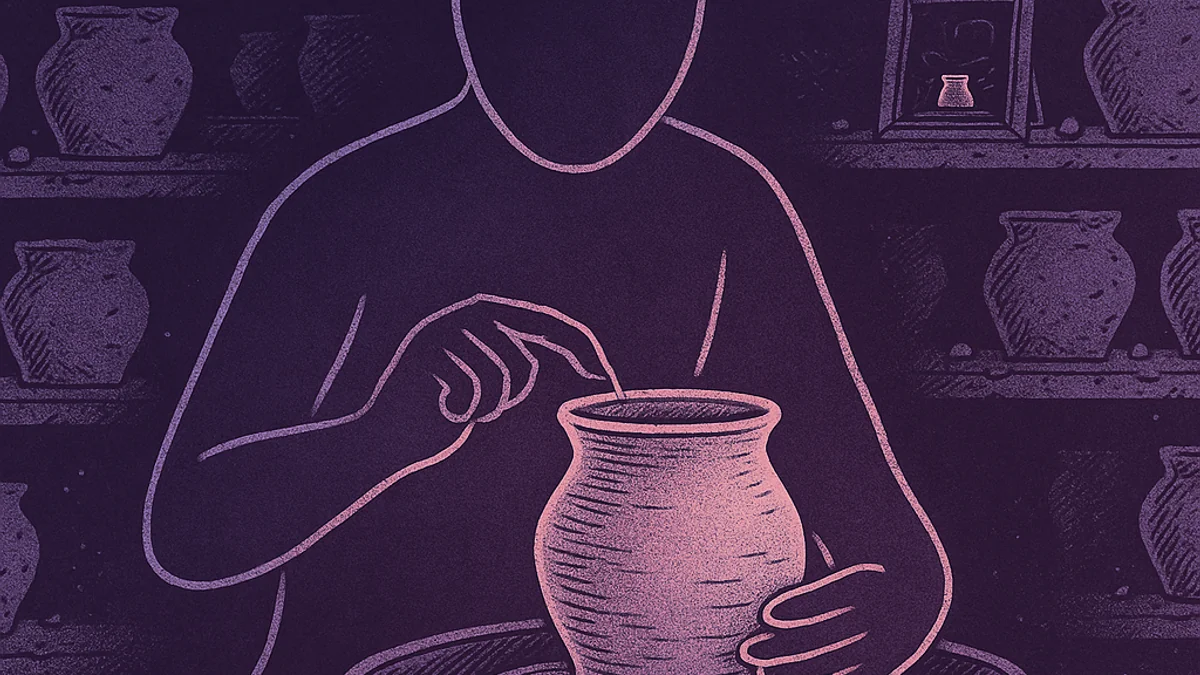
Consider a home potter. Someone with a wheel in their garage, a little kiln, a shelf full of bowls. They throw a bowl on Saturday morning. The bowl is fine. Some bowls are better than others. Some are misshapen and get trashed. Some are good enough to use as serving dishes; some are good enough to give away at the holidays. None of them are going to become anything else. The potter isn’t going to open a shop. The bowls aren’t going to scale. The potter is going to keep throwing bowls for the next thirty years, and the throwing is the point, and the bowls are the byproduct.
We have a whole cultural category for this. It’s called craft. We know exactly how to think about a home potter. We don’t ask the potter when they’re going to quit their day job. We don’t ask them to write a Medium post about their bowl-throwing journey. We don’t tell them their bowls are potential businesses. We just say, “oh, you make pottery. That’s nice. Can I have one?”
The side project isn’t a business in waiting. It’s pottery.
Here’s the thing that took me a long time to see: software has never had this category before. Every other creative discipline has a hobbyist mode that exists comfortably alongside the professional mode. Home cooks and restaurant chefs. Garage musicians and studio musicians. Weekend photographers and working photographers. The hobbyists aren’t failed professionals. They’re a different, fully-legitimate thing, and nobody confuses them.
Software never had this because software was always expensive. Expensive enough that you had to be trying to make it mean something in order to justify doing it. There was no such thing as a software hobbyist — not really. There were solo developers with ambition and solo developers with shelved projects, but both groups were telling themselves a business-outcome story because the cost of software demanded one.
Agents dropped the cost to near-zero. And for the first time, there’s room for an honest hobbyist mode. Which means there’s room to admit that’s what most of us are actually doing.
Why Nobody Says This Out Loud
Here’s the part that makes me uncomfortable. I’m going to write it quickly and move on.
Most of the people who post on LinkedIn about their weekend builds are not founders in waiting. They’re hobbyists. Most of the people who describe their side projects as “optionality” have never exercised an option on one of them, and they’re not going to. Most of the “building in public” threads are performance — not of dishonesty, exactly, but of a story everyone knows how to tell because everyone learned it at the same time from the same sources.
The performance works because the alternative is uncomfortable. The alternative is saying, in public, with your real name attached: I make software as a hobby now. I have a job. I’m not going to monetize the things I build on Saturdays. I’m not accumulating anything. I’m just throwing bowls.
That admission sounds like giving up. It isn’t. It’s a category correction. It’s refusing to pretend that every piece of work you do has to point at a startup, a promotion, or a personal brand. It’s saying out loud that you make things because making things is one of the ways you’re alive, and that’s a complete sentence — and the startup you’re not building doesn’t need to show up in the sentence at all.
I think the reason people don’t say this out loud is that the founder-in-waiting story is the only story software culture has given solo builders to tell about themselves. Take the story away and the culture has nothing to offer in its place. Everyone feels the absence, but nobody wants to be the first one to name it — because the one who names it sounds like they lost the game.
But nobody was playing a game. The “game” was a side effect of scarcity. Remove the scarcity and the game reveals itself as a costume everyone was wearing over the actual activity, which was making things for the sake of making them.
The One Thing That Isn’t a Relief
There’s a piece of this that isn’t comfortable, and I’d rather name it than pretend it’s not there.
Pottery only works if you have a day job.
The home potter can throw bowls on Saturday because the mortgage is getting paid by something else. If the bowls had to feed her, she’d be a professional potter, and the work would collapse back into the logic of commerce. Specialization. Volume. Repetition of the things that sell. Rejection of the things that don’t. The thing that makes hobbyist work feel free is that nothing material depends on it.
Most people reading this have day jobs. I have a day job. The solo-builder ideology is almost exclusively practiced by people who already have stable income from somewhere else — a company, a partner, a runway, a pension. The “solo founder” narrative obscures this because it’s less marketable than “senior engineer with a side interest.” But the economic facts are what they are. Without the day job, the pottery can’t exist.
Which means the honest version of the story isn’t “I’m a solo builder.” It’s “I have a stable job and I make things on the side for reasons that have nothing to do with the market.” That sentence doesn’t do as well on LinkedIn. It also happens to be true.
There’s a harder piece here I almost skipped. The day job doesn’t just fund the pottery — it was earned, in part, by the pottery. Side projects were doing reputation work whether I framed them that way or not. The founder-in-waiting story may have been false, but the signal underneath it — this person still ships — was real, and it helped make me employable as a Product Architect in a market that is currently re-pricing what that title even means.
Calling the side projects pottery means giving up that signal at the exact moment the market is flooded with people who built something with an agent this weekend, and is trying to figure out which of them count. Stepping out of that competition has a specific 2026 cost. I’m not pretending it doesn’t.
What I’m choosing, with eyes open, is to trade signal for something I can’t put on a resume. Some days that feels right. Some days I wonder if I’ll regret it when the market reprices what I gave up.
And it has a consequence most of us haven’t absorbed yet. If the thing I’m making isn’t a business, I should stop treating it like one. I should stop asking whether it has product-market fit. I should stop asking whether it would scale. I should stop asking whether it’s defensible, or acquirable, or unique in the market. Those are questions for a restaurant. I’m throwing a bowl. The only question is whether the bowl is any good, and whether I want to keep throwing bowls tomorrow.
A Potter Smashes the Bad Ones
Here’s the test that made me realize how incomplete my own frame was.
A real potter doesn’t keep every bowl. The misshapen ones get broken. The cracked ones get trashed. The ones that come out of the kiln wrong get thrown against the studio wall, because the physical act of destruction is part of the practice. A home potter’s shelves are curated. What’s on them is there because it earned a spot, and what’s in the trash is there because it didn’t.
I have deleted zero repos in the last six months.
I’ve archived some. I’ve stopped working on many. I’ve renamed a few to hide them from myself at the top of the folder listing. But I haven’t deleted any of them. And the reason I haven’t is the reason the whole pottery frame is under suspicion: I’m still, somewhere below the stated story, treating them as capital. Capital you might come back to. Capital you don’t throw away even when you’re pretty sure you’ll never touch it again.
The honest version of pottery requires a delete key you actually use. I don’t use it. Most solo developers I know don’t use it either. That failure — the one we’re all committing together — is probably the most durable evidence that the business-in-waiting story still has us, even when we’ve consciously retired it.
Naming this doesn’t fix it. But I’d rather write the post with the failure on the page than pretend the frame is cleaner than I’ve earned the right to claim.
Relief and Grief, Both
I don’t know yet whether this is a relief or a quiet kind of grief.
Some days the reframe lands as permission. Permission to make things without having to defend why they exist. Permission to finish something and move on without turning it into a LinkedIn post about the lessons I learned. Permission to love the making instead of narrating it into a strategy. Those days it feels like I’ve put down a backpack I didn’t know I was carrying.
Other days it lands as loss. There was a version of me that was going to be a founder, or at least a person whose side projects were leading somewhere. That version was never real — the evidence was always in the drawer — but the image of that version was real, and I’d been treating it like a plan. Letting it go feels like something.
Both are true. I haven’t absorbed all of it yet. What I can tell you is that the Saturday builds have felt different since I stopped asking them to be capital. Lighter. More honest. More mine.
One caveat before I close, because it’s going to matter. The pottery frame works at this level of agent capability. Right now, “making” still includes reading, shaping, debugging, rejecting — texture I can feel in my hands and in my head. If agents eventually compress that whole loop down to a prompt, the analogy stops working. What’s left won’t be pottery. It’ll be something else, and I don’t yet have a word for it. That’s not this year’s question, but it’s a year closer than it was last time I wrote about it.
The backpack is off. What happens next is the rest of the piece I haven’t written yet.
I’m going to go throw another bowl.