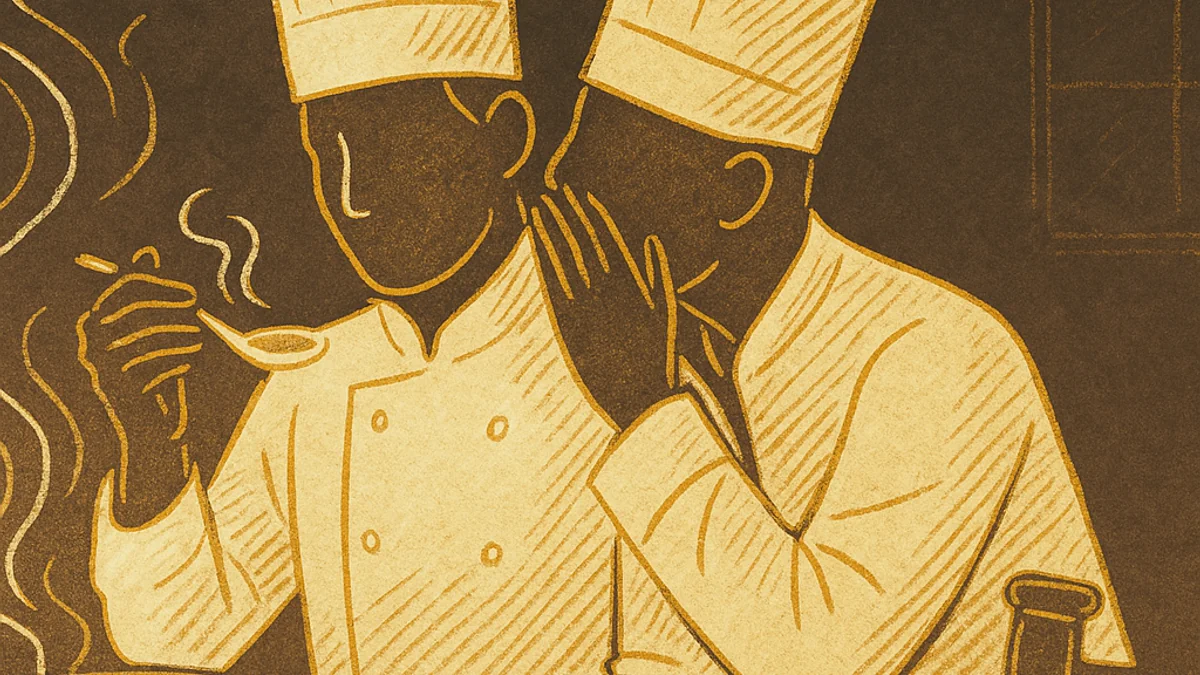
The Question That Isn't a Question
Someone asks you a question. You answer it carefully. They don't react to your answer — they ask the next question. That's when you realize the first one wasn't a question. The move has a shape, and it has a specific cost to builders who share work in drafts.
Nino Chavez
Product Architect at commerce.com
Someone asks you a question. You answer it carefully. They don’t react to your answer — they ask the next question. That’s when you realize the first one wasn’t a question.
It’s a move that doesn’t have a good name, and I think it’s the thing that actually makes cooking in public dangerous for builders.
It sounds like: “Have you considered X?” Or “What happens when Y?” Or “How does this handle Z?” Structurally, it’s inquiry. Delivered, it’s verdict. The meaning isn’t “I’m curious, tell me more.” The meaning is: I already thought of X, you didn’t, therefore this doesn’t count. The question is a delivery mechanism for a conclusion the asker reached before you finished showing them the thing.
To see why this particular move is uniquely bad, it helps to separate two things that get lumped together as “feedback.”
One kind measures the plate against a standard brought in from outside. It doesn’t require knowing how to cook. It tells you how the thing landed — whether it was good, whether it worked, whether someone would come back for more. Call it critic feedback. It’s about effect.
The other measures against the constraints you were working under. It recognizes the move. It knows what was in the walk-in and what wasn’t. It can tell the difference between a shortcut that worked and a compromise that didn’t. Call it chef feedback. It’s about choice.
Both are useful. They’re useful at different times. Critic feedback is useful when the thing is finished and you’re trying to figure out if it worked. Chef feedback is useful while you’re still making it, when the choices are still reversible and knowing which ones were good is the point.
The fake question is a critic’s verdict wearing a chef’s uniform.
Structurally — pointed, specific, engaging with a decision — it is indistinguishable from the thing you were hoping for. That’s why it lands. You can’t dismiss it the way you’d dismiss a straight “this sucks,” because a straight “this sucks” is on record as evaluation and you can weigh it against other evaluations. A fake question you have to answer. That’s the trap. You can’t tell, in the moment, whether the person is engaging or grading. So you do the respectful thing. You take it seriously, you walk through your reasoning, you explain the tradeoff you considered, the constraint you were working under, the version you already tried. And the asker, having extracted the concession they came for, moves on to the next “question.”
The transaction was never feedback. It was a performance of evaluation, with you as the unpaid actor.
Here’s what makes this specifically corrosive to builders, as opposed to writers or speakers or anyone else who makes things for public judgment.
Builders work in drafts. The whole point of showing a v0.2 is to test a premise before it gets expensive to change. The ask, implicit in every rough demo, is: treat this like a question I’m asking you, not a statement I’m asking you to grade.
When the room responds with real questions — generative ones, the kind that open up new branches — the draft does its job. When the room responds with fake questions, the draft gets punished for being a draft.
And punished specifically. Because a fake question always pulls on the same thread: completeness. “Have you considered…” reads as “this is incomplete,” and incompleteness is the defining feature of a draft. So the builder spends their reply defending the draftness of the draft, which is the one thing a draft was supposed to be allowed to be.
Do this enough times and you learn, without ever deciding to, that the only things safe to share are things that are no longer drafts. You stop showing v0.2. You start showing v1.0. You’re still “building in public.” You’re just building in public with nothing left to find out.
The failure mode isn’t “people were mean.” It’s “people were fluent in the wrong dialect, and you slowly learned to speak it back.”
I have to deal with the obvious counter, because it’s a good one: every pointed question can’t be in bad faith. Sometimes people ask hard questions because they’re the right questions. Yes. Exactly right. This is the reason the move is hard to call out — because real chef questions and fake chef questions look identical on the surface. Both are pointed. Both name something you didn’t address. Both make you defensive if you’re tired.
The tell is what happens after your answer.
A real question treats your answer as information. If you say “I considered X and rejected it because of Y,” the asker either accepts Y, pushes on Y specifically, or pivots to something new that your answer revealed. The conversation moves. They learned something from your reply, and you learn something from what they do with it.
A fake question treats your answer as noise to be talked past. The asker has already moved on, or doubled down on a different angle, or restated the original concern in new words as if you hadn’t answered at all. Your reasoning didn’t update them because updating was never the goal. The goal was the performance, and your explanation was just the part of the performance where the audience politely waits.
If you’re trying to figure out, in real time, which kind of question you’re getting — answer it once, carefully and directly, and watch what happens in the next beat. That’s the entire test.
The cost of this move isn’t just to the builder who gets caught by it. It’s to the room.
Every time a fake question gets mistaken for a real one, and the builder responds with the full walk-through, the ceiling on what can be shared in that room drops a little. Other builders watching the exchange update their own sense of what’s safe to post. They post less rough work. They post more polished work. The room starts selecting for performances of finishedness instead of thinking in progress, and over time it becomes a room nobody would have wanted to cook in in the first place.
Which is why none of this resolves into “find a better audience” or “post anyway.” It’s a curation problem, not a courage problem. When you share something unfinished, the real act isn’t exposure — it’s holding up a flare and watching who walks toward it. Some people walk toward it to build on what you showed them. Some walk toward it to grade it, which is useful too, just not now. And some walk toward it performing the first while doing the second, and they’re the ones you lose the ability to see coming before it’s too late.
The thing I want to say, that I’m not sure how to say without sounding ungenerous, is this: if you recognize yourself in the description of the question-that-isn’t-a-question, the useful move isn’t to stop asking pointed questions. It’s to notice whether you’re asking to learn or asking to win. The questions look identical from the outside. The difference is only ever in what you do with the answer.